HISTORICAL PIGMENT ARCHITECTURE
Ancient Cinnabar Alchemy & The Legendary Chinese Vermilion
Genuine Vermilion (Color Index PR106) holds the most storied pedigree in the history of inorganic color. Sourced from natural mineral cinnabar deposits in Almadén (Spain), Idrija (Slovenia), and Hunan province (China), this heavy mercuric sulfide mineral was mined since Neolithic times and prized by ancient civilizations as the sacred color of life, immortality, and imperial sovereignty.
In ancient China, alchemists developed the 'dry-process' synthesis of vermilion by heating elemental mercury and sulfur in sealed clay retorts, followed by sublimation and prolonged levigation. The resulting 'Chinese Vermilion' was so exquisitely pure and brilliant that it became the international standard of luxury, exported across the Silk Road to Rome and Renaissance Europe.
Throughout the Middle Ages and Renaissance, Vermilion was the undisputed monarch of the red palette, immortalized in illuminated manuscripts, Byzantine icons, and masterpieces by Giotto, Titian, and Rubens. Its reign lasted until the 20th-century introduction of non-toxic cadmium and pyrrole reds.
CHEMICAL SPECIFICATION & OPTICAL DATA
Mercuric Sulfide Semiconductor Physics, Metacinnabar Phase Shift & Optics
Chemically formulated as mercury(II) sulfide (α-HgS), Vermilion crystallizes in a trigonal (hexagonal) cinnabar crystal lattice composed of infinite helical -Hg-S-Hg- chains. It is a direct-bandgap semiconductor with a bandgap energy of approximately 2.10 eV, absorbing all photon wavelengths below 580nm with immense efficiency.
This sharp semiconductor absorption edge produces total absorption across the blue and green spectra, while reflecting over 90% of incident light across the scarlet-red spectrum (600–720nm). With an extraordinarily high refractive index of 2.81 to 3.14, Vermilion possesses legendary optical hiding power and radiant scarlet brilliance.
Despite its inorganic permanence, PR106 carries an ASTM Lightfastness Class II-III rating due to a famous photochemical phenomenon: in the presence of trace chloride ions and solar UV radiation, red α-HgS can undergo an irreversible allotropic phase transformation into black cubic metacinnabar (β-HgS), famously causing some Pompeian murals and Renaissance draperies to darken over centuries.
ART HISTORICAL HERITAGE
Art Historical Heritage: Pompeii Frescoes, Titian & Rubens' Baroque Drama
The visual majesty of European master painting is inextricably linked to genuine Vermilion. In the Roman wall paintings of Pompeii and Herculaneum, cinnabar vermilion adorned the opulent villas of Roman patricians, establishing the iconic 'Pompeian Red' that still defines classical architecture.
Venetian Renaissance master Titian utilized Vermilion with masterful dramatic power, pairing its opaque scarlet brilliance against deep ultramarine blues and golden ochres in his monumental altarpiece *The Assumption of the Virgin*. Peter Paul Rubens later used vermilion impastos to inject pulsating vitality and blood warmth into Baroque flesh tones.
In contemporary museum conservation, paintings containing PR106 are treated with extreme care to prevent chlorine-catalyzed blackening. While modern ateliers utilize non-toxic DPP substitutes, genuine Vermilion remains the historic standard of red brilliance.
STUDIO CRAFT & MATERIAL PRACTICE
Atelier Practice: Heavy Mineral Washes & Paraffin Boundaries
In Coloartura's atelier in Ermelo, genuine mineral Vermilion (PR106) is curated and studied under strict museum conservation protocols over heavy 300gsm cold-pressed cotton paper. The natural weight of the mercuric sulfide crystals produces a dense, opaque mineral body that coats the paper tooth.
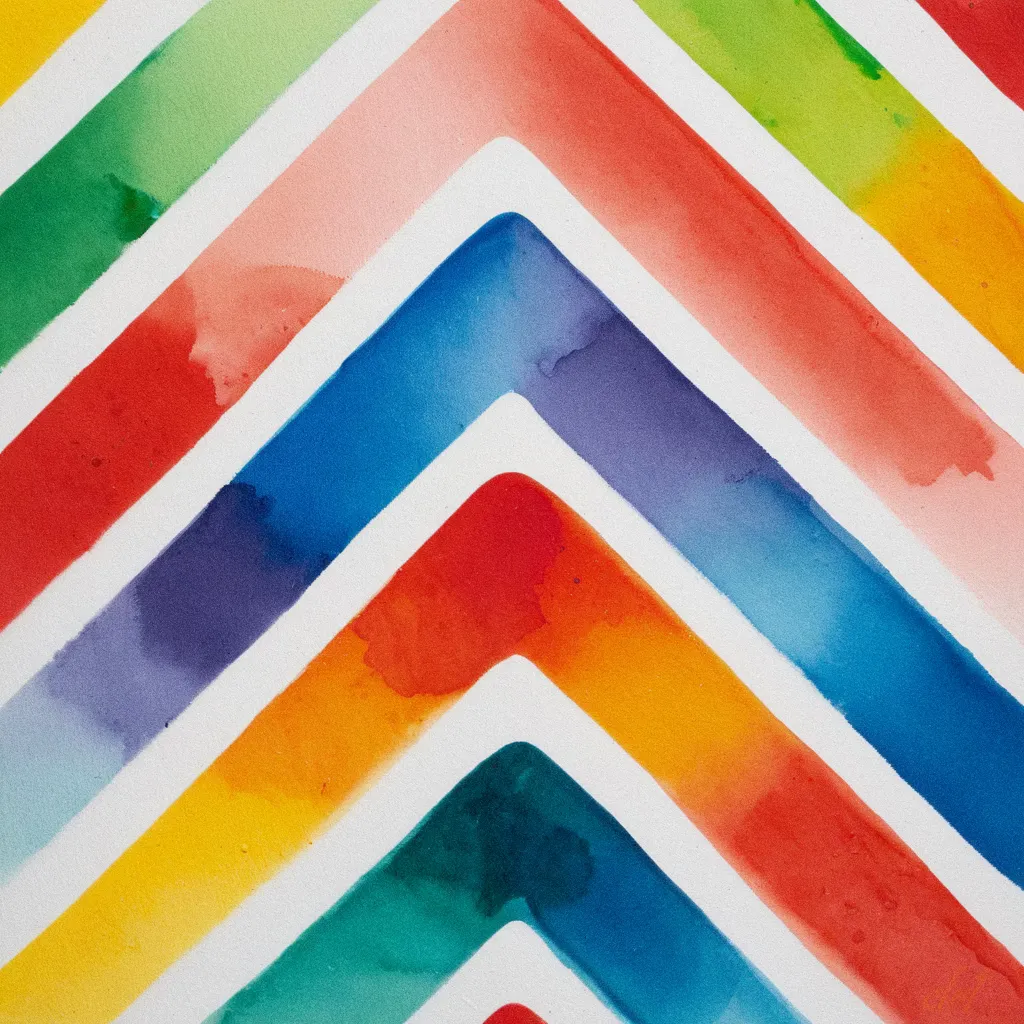
When washed against hydrophobic wax crayon resist boundaries, PR106 creates bold, opaque color fields bounded by the white wax lines. This juxtaposition between heavy mineral scarlet and crisp geometric boundaries defines Coloartura's 1:1 square masterworks.