HISTORICAL PIGMENT ARCHITECTURE
From Afghan Mountain Lapis to Guimet's 1828 Breakthrough
Throughout the Medieval and Renaissance eras, natural Ultramarine ('oltremarino'—from beyond the sea) was extracted through laborious resin purification of lapis lazuli mined exclusively in the Badakhshan mountains of modern Afghanistan. Reserved strictly for the robes of Christ and the Virgin Mary, it cost more than its weight in pure bullion.
In 1824, the French Société d'Encouragement pour l'Industrie Nationale offered a prestigious 6,000-franc prize for the invention of a commercially viable synthetic ultramarine. In 1828, French industrialist Jean-Baptiste Guimet in Toulouse synthesized pure synthetic ultramarine, closely followed by German chemist Christian Gmelin in Tübingen.
Guimet's breakthrough democratized the most sacred color in art history, allowing artists across the globe access to an intense, warm lapis blue without astronomical financial barriers.
CHEMICAL SPECIFICATION & OPTICAL DATA
Sodalite Cage Chemistry & Radical Polysulfide Physics
French Ultramarine (Color Index PB29) is a complex sulfur-containing aluminosilicate zeolite with a sodalite cage crystal framework [Na₈₋₁₀Al₆Si₆O₂₄S₂₋₄]. The intense blue color originates from trapped trisulfur radical anions (S₃⁻) enclosed within the aluminosilicate cages.
These radical anions create an intense electronic charge transfer transition that absorbs strongly across the yellow-orange-red spectrum (centered at ~600 nm), reflecting radiant wavelengths at the short-wave blue-violet boundary (~450 nm). This imparts Ultramarine's unmistakable warm, reddish-blue undertone.
Rated ASTM Lightfastness Class I, French Ultramarine possesses absolute resistance to solar irradiation and alkalis, though it remains sensitive to strong acids which can decompose the sodalite cage structure, releasing trace hydrogen sulfide gas.
ART HISTORICAL HERITAGE
Art Historical Heritage: From Vermeer to Yves Klein
Johannes Vermeer famously plunged his family into debt purchasing natural lapis ultramarine for masterworks like 'Girl with a Pearl Earring' and 'The Milkmaid'. Two centuries later, the synthetic version enabled Impressionists like Monet and Renoir to discard black paint entirely, constructing rich shadows from pure Ultramarine washes.
In the mid-20th century, French artist Yves Klein collaborated with chemical technicians to formulate International Klein Blue (IKB), using synthetic Ultramarine PB29 suspended in a matte synthetic resin (Rhodopas M) to express pure spatial infinity.
French Ultramarine stands as a symbol of deep contemplative space, spiritual transcendence, and optical warmth throughout art history.
STUDIO CRAFT & MATERIAL PRACTICE
Atelier Execution: Textural Granulation & Cold-Pressed Washes
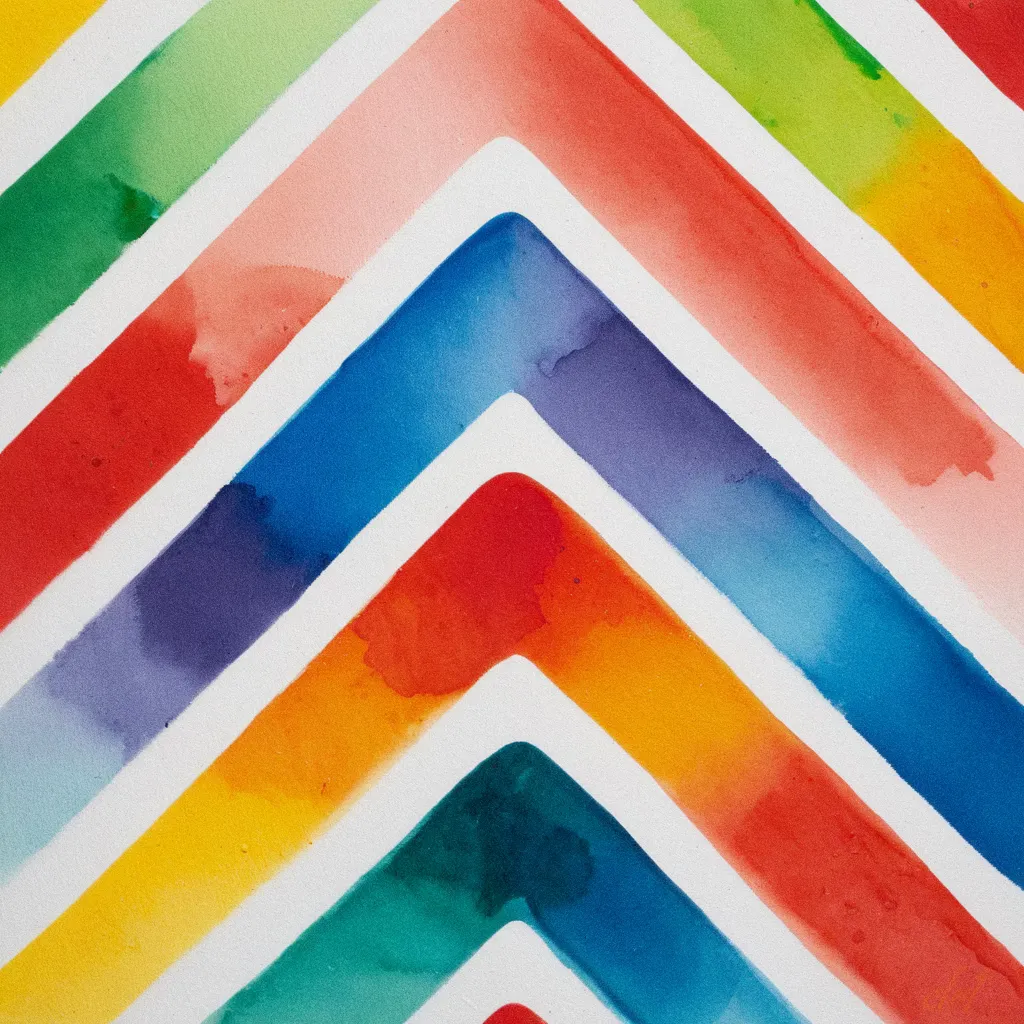
In the Coloartura atelier in Ermelo, French Ultramarine PB29 is applied in saturated, wet-in-wet watercolor washes on 300gsm cold-pressed cotton paper.
PB29 exhibits pronounced particulate granulation: microscopic pigment clusters migrate into the depressions of the cotton paper, creating an organic, stone-like reticulation. When bordered by wax crayon resist lines, this physical settling produces striking textural contrasts between liquid freedom and geometric order.